

5G May Be the Future. But 4G Is Not the Past.
For a long time, mobile technology transitions were fairly easy to describe. One generation replaced another. I think it’s becoming clear that the next phase of IoT will not be quite that simple.

November 17, 2026
What we see instead is a more hybrid landscape, where 4G, 5G and other technologies will coexist for many years. 4G still provides broad global reach and a mature device ecosystem. 5G Standalone is developing, but availability and global roaming support are still uneven, and technologies such as 5G RedCap are not yet a universal replacement for 4G. That makes the technology decision more complex.
A device launched in 2027 may still be operating around 2040. So the question is not simply: “Should we choose 4G or 5G?” It is: “What connectivity setup makes sense for this product throughout its lifetime?”
For many products, 4G will remain a very sensible choice for years to come. Our current view is that 4G will remain broadly available well into the 2040s. And the forecasts support that picture. Berg Insight expects LTE Cat-1/Cat-4+ connections to continue growing through 2030, reaching around 4.2 billion connections, compared with roughly 0.75 billion for 5G.
For others, particularly products with very long lifecycles, it may make sense to build in support for both 4G and 5G SA. That can mean higher hardware cost and complexity, and the ecosystem is not equally mature for every use case.
And the landscape is broader than simply 4G versus 5G. RedCap, LTE-M, NB-IoT and, for some applications, satellite connectivity will all have different roles to play depending on the use case.
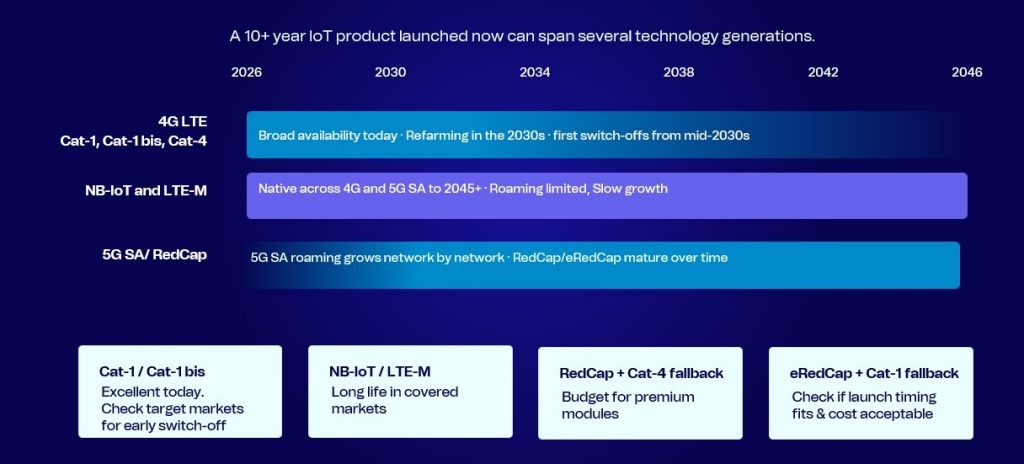
This means future-proofing is becoming less about choosing the technology that will “win” and more about building for a landscape where several technologies coexist.
At Telenor IoT, these are discussions we have increasingly often with customers. If you are reviewing your own connectivity roadmap, we have gathered our latest view and recommendations in our recent webinar: The 5G IoT Reality Check: RedCap, Cat-1, and Building Devices to Last 10+ Years.
My takeaway is fairly simple: don’t start with the technology. Start with how long the product needs to live, where it needs to work and what you need from it over time.