

Telenor IoT and Sateliot Announce Partnership to Enable Seamless Terrestrial–Satellite IoT Connectivity
Telenor IoT has announced a partnership with Sateliot focused on terrestrial-satellite IoT connectivity based on 3GPP Release 17 NTN.
Managed Connectivity Services
FEATURES & CAPABILITIES
IoT Connectivity Platform IoT Roaming Roaming Selection Tool Global Connectivity Global IoT SIMs Data Analytics & AI Security in IoTManaged Connectivity Services
FEATURES & CAPABILITIES
IoT Connectivity Platform IoT Roaming Roaming Selection Tool Global Connectivity Global IoT SIMs Data Analytics & AI Security in IoTSatellite IoT extends cellular connectivity to remote assets using satellite-based Non-Terrestrial Networks (NTN).
Last updated: May 2026
Definition: Satellite IoT, also known as IoT via Non-Terrestrial Networks (NTN), refers to IoT connectivity delivered through satellites instead of, or in addition to, terrestrial base stations. Devices send and receive data via satellite links, enabling connectivity in remote, maritime, rural, or hard-to-reach areas where mobile networks are limited or unavailable.
Satellite IoT is not new. Industries such as maritime, utilities, oil and gas, and logistics have relied on satellite-based connectivity for decades.
What is new is how quickly the technology is evolving. Traditionally, satellite IoT required specialized hardware and often costly infrastructure. Today, innovation in cellular standards, satellite constellations, and device ecosystems has opened the door for standardized, low-power IoT devices to connect directly to satellites in space.
A new generation of satellite technology is emerging that is designed to integrate more closely with mobile networks, offering coverage and resilience in places where terrestrial networks do not reach.
Satellite IoT connects devices through orbiting satellites, including GEO satellites positioned over the equator and LEO satellite constellations that move across the sky. It forms part of the 5G Non-Terrestrial Networks (NTN) evolution defined by 3GPP in Release 17, with enhancements in Release 18 and ongoing development in Release 19, which aims to further integrate satellite and cellular systems under a unified standard.
Satellite IoT complements technologies such as NB-IoT, LTE-M, LTE Cat-1 and 5G RedCap, helping create a more unified and interoperable ecosystem for global IoT deployments.
Satellite IoT is not a default choice for every IoT deployment. For most fixed and urban IoT use cases, terrestrial mobile networks remain the most practical and cost-effective option.
Satellite IoT becomes relevant when assets operate outside reliable terrestrial coverage, data volumes are low, communication is non-time-critical, and the business value of visibility outweighs the added hardware and airtime costs. This makes it especially relevant for high-value mobile assets, remote infrastructure, maritime operations, agriculture, utilities, and industrial environments where coverage gaps create operational risk.
For many enterprise deployments, the most practical model is terrestrial-first. Devices should prioritize cost-efficient terrestrial networks such as LTE-M, NB-IoT, LTE Cat-1, or 5G where available, and use satellite connectivity for exception handling, critical alerts, status updates, or location messages when terrestrial coverage is unavailable.
A new era of simpler, more capable satellite IoT is emerging. Several trends support this:
1. One device that can connect to both cellular and satellite networks
Chipset providers are developing modems and antennas that allow IoT devices to connect to both cellular and satellite networks. This drastically simplifies hardware design and reduces costs.
2. New satellites are smaller and cheaper
Many new satellites are being deployed in Low Earth Orbit. They are lighter, cheaper to build and cheaper to launch, making larger constellations possible.
3. A rapidly evolving ecosystem
There are more than forty companies active in satellite IoT or related services. Established satellite operators, emerging startups and mobile industry vendors are all innovating in this area.
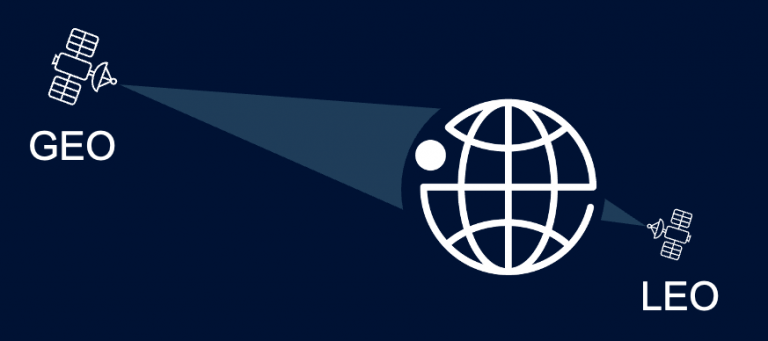
Direct-to-device means standard IoT modules or smartphones can connect directly to a satellite.
There are two technological paths to achieve this:
The cellular standardisation organisation 3GPP included support for Non-Terrestrial Networks in Release 17 in 2022, with improvements in Release 18. In this model, devices are aware that they are connecting to a satellite and have logic to handle the unique requirements this imposes.
Examples of satellite vendors choosing this path include Sateliot, Iridium, Skylo and OQ Technology.
In this model, the satellite behaves like a cellular base station, enabling devices that already support LTE to connect with little or no modification.
Examples include Starlink, AST SpaceMobile and Lynk.
For readers who want deeper technical context, see the GSMA Non-Terrestrial Networks white paper and the 3GPP NTN overview.
Telenor IoT has announced a partnership with Sateliot focused on terrestrial-satellite IoT connectivity based on 3GPP Release 17 NTN.
Satellite IoT use cases span a wide range of industrial and environmental sectors:
Tracking vessels, monitoring engines, cargo visibility and safety systems.
Livestock monitoring, irrigation management, environment sensors and machinery telemetry.
Pipeline monitoring, grid infrastructure, leak detection and remote asset management.
Container tracking, trailer monitoring, route visibility and cold chain tracking.
Wildfire detection, flood sensors and weather stations.
Equipment monitoring, worker safety, material tracking and remote operations.
Recent market analysis highlights the scale of this opportunity.
According to Berg Insight reports the global satellite IoT subscriber base reached around 5.8 million in 2024 and is forecast to reach approximately 32.5 million units by 2029.
IoT Analytics say growth is driven by lower launch and hardware costs, hybrid multi orbit strategies and increasing adoption in automotive and transport industries.
Satellite IoT is advancing quickly, but coverage and performance still depend on satellite constellation maturity, device readiness, chipset support, and regulatory dynamics. In some regions, connectivity may be intermittent as constellations continue to expand, with communication limited to specific satellite coverage windows rather than continuous availability.
As NTN standards and chipsets evolve, a broader range of NTN-capable devices is expected to enter the market. However, practical performance also depends on factors such as latitude, satellite passes, antenna design, power management, regulatory alignment, and service integration. As a result, today’s NTN-based IoT is best suited for low-data, non-time-critical use cases rather than continuous, high-bandwidth, or real-time applications.
The emerging NTN landscape includes a wide mix of operators with different strategic focuses. Many of the newcomers using LTE from space approaches are primarily targeting direct to phone services. Their initial emphasis is on messaging, emergency connectivity and, over time, full mobile coverage for consumer devices.
In parallel, another group of players is concentrating on IoT centric NTN, typically using NB-IoT or similar low power standards with small satellites and narrowband capacity. Their goal is global, low data scenarios like sensors and trackers, rather than consumer broadband.
Established satellite operators also play a role as they gradually add 3GPP NTN support on top of their existing constellations.
Even though Satellite IoT is promising, it still faces several challenges in comparison to terrestrial connectivity:
Despite the challenges, the momentum is unmistakable. Falling launch costs, maturing standards, and strong interest from both operators and enterprises are driving rapid development.
Satellite is evolving from a specialized technology into a core extension of mobile networks — one that brings true global IoT coverage within reach.
As constellations expand and device ecosystems mature, satellite connectivity will become a natural part of IoT deployments, providing resilience, reach, and new possibilities across industries worldwide.

Satellite IoT provides continuous visibility for assets that move or operate outside terrestrial coverage — such as shipping containers, vehicles, and industrial equipment in isolated areas. It ensures that locations, conditions and alerts can be monitored anywhere on Earth.
Cellular IoT uses terrestrial mobile networks with ground-based base stations. Satellite IoT uses satellites in low Earth orbit (LEO) and geostationary orbit (GEO) to provide coverage in areas that terrestrial networks do not reach. New modern devices can support both technologies, switching automatically between them to maintain seamless global connectivity.
Satellite IoT is best suited for operations in regions with little or no cellular coverage, or where network resilience is critical, for example in maritime transport, mining, energy production, agriculture, logistics, or environmental monitoring.
For most IoT deployments, terrestrial mobile networks remain the most practical and cost-effective option. Satellite IoT becomes relevant when assets operate outside reliable terrestrial coverage, data volumes are low, communication is non-time-critical, and the business value of visibility outweighs the added hardware and airtime costs.
In many enterprise deployments, the best model is terrestrial-first: devices use cellular networks whenever available and rely on satellite connectivity as a fallback for critical alerts, status updates, or location messages when terrestrial coverage is unavailable.
It offers global reach, reliable communication in remote locations or open seas, integration with cellular IoT management platforms, and secure communication based on 3GPP non-terrestrial network standards.
Satellite IoT has higher latency and lower throughput than terrestrial networks, and many systems today support only small data packets. Real time voice services are not yet practical for most satellite IoT solutions.
Coverage can also be intermittent when constellations have a limited number of satellites, which means overpasses may occur only a few times per day.
Devices require a clear line of sight to the sky, so indoor connectivity can be challenging. Satellite transmission also consumes more power than cellular IoT, which affects battery life for small devices.
As standards such as 3GPP NTN evolve and constellations expand, these constraints are expected to reduce.
A quarterly newsletter to help you stay up to date on the trends and developments shaping global IoT.
Managed IoT connectivity for enterprises operating across markets and large-scale deployments, with operational oversight and lifecycle support built in.
Global vehicle connectivity with built-in compliance and support for software-defined vehicles, helping car manufacturers deliver connected services at scale.
Devices, SIMs, and data management in one service, supporting connected products from launch to scale without building your own IoT stack.