

Sony’s IoT Asset Tracking Solution Enabled by LTE-M Connectivity
Visilion, an innovative service from Sony is tracking assets from spare parts on the Silk Road to ventilators in time-pressured hospitals globally.
Managed Connectivity Services
FEATURES & CAPABILITIES
IoT Connectivity Platform IoT Roaming Roaming Selection Tool Global Connectivity Global IoT SIMs Data Analytics & AI Security in IoTLast updated: October 2026
LTE-M is a low-power cellular IoT technology designed for devices that need long battery life, mobility, enhanced coverage, and more responsive communication than narrowband alternatives.
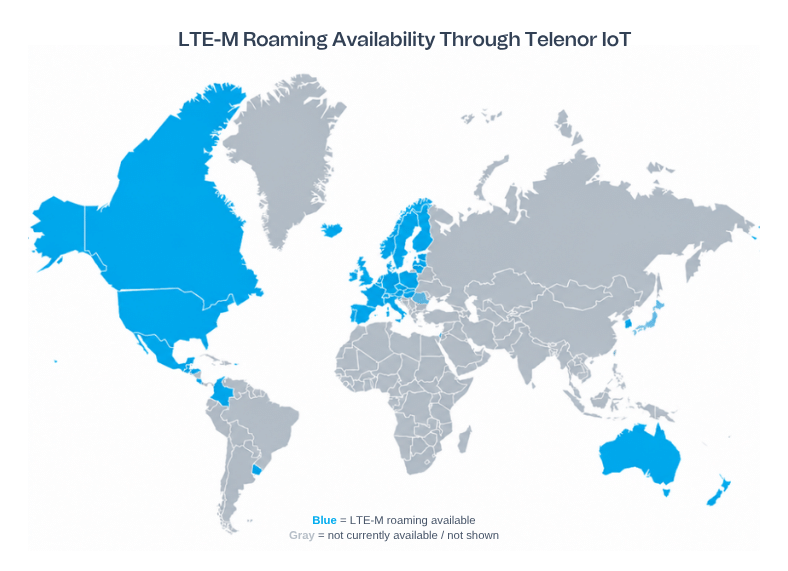
LTE-M is commercially deployed across markets in Europe and Americas, as well as Japan, South Korea, and Australia, although availability is not uniform worldwide. It can be a strong fit for applications such as asset tracking, wearables, and remote monitoring. For regional and international deployments, network availability, roaming, and required LTE-M features should still be confirmed across the markets where devices will operate.
LTE-M is a 4G LTE Low-Power Wide-Area (LPWA) technology standardized by 3GPP in Release 13 for IoT. It combines power-saving features and enhanced coverage with mobility and enough data capacity for many tracking, monitoring, and control applications.
LTE-M is part of the LTE family rather than a separate network generation. Compared with standard LTE categories such as LTE Cat-1, it prioritizes lower power consumption and coverage enhancement over higher data rates. Compared with NB-IoT, it generally provides greater mobility, higher throughput, and lower latency.
LTE-M is the common industry term; LTE Cat-M1 is the corresponding LTE device category introduced for LTE-M. For clarity, we use LTE-M throughout this page unless the specific device category matters.
LTE Cat-1 is a separate LTE device category. Cat-1 offers higher throughput and benefits from the broad availability and mature roaming infrastructure of standard 4G LTE. LTE-M is more strongly optimized for low power consumption and enhanced coverage.
Cat-1 was defined in the first LTE release, 3GPP Release 8. Cat-1 bis was added later in Release 13 as a device-side simplification of Cat-1.
This distinction matters when selecting modules and comparing connectivity options: LTE-M and LTE Cat-1 have different capabilities and deployment profiles.
| Characteristic | LTE-M |
|---|---|
| Technology family | Cellular LPWA / 4G LTE |
| Device category | LTE Cat-M1 |
| Data rate | Hundreds of kilobits per second |
| Power efficiency | High; supports PSM and eDRX |
| Mobility | Supports cell handover |
| Coverage | Enhanced-coverage modes available |
| Responsiveness | Higher than NB-IoT for many applications |
| Voice / VoLTE | Supported by specification; operator availability is very limited |
| Network availability | Commercially deployed across many markets, but not fully global |
| Roaming | Available where supported by networks and commercial roaming agreements |
| Typical fit | Battery-powered devices, trackers, wearables, monitoring, and selected metering applications |
Real-world performance also depends on network configuration, radio conditions, module and firmware implementation, and operator support for specific LTE-M features.
What about Cat-M2? LTE Cat-M2 was introduced later in 3GPP Release 14 and extends LTE-M with higher data-rate capabilities. Operator adoption has remained limited, however, and Cat-M2 is not yet common in many regions.
LTE-M was introduced as an LTE radio technology in 3GPP Release 13, so its radio access is based on LTE rather than 5G New Radio (NR).
At the same time, LTE-M is part of the 5G Massive IoT standards roadmap and can connect to a 5G Standalone core. LTE-M can also be deployed within 5G NR carriers, so it can continue to operate as operators move spectrum from 4G to 5G. This makes LTE-M a strong option for long-lived IoT deployments, with support expected well beyond 2040.
In practical terms, LTE-M remains an LTE-based radio technology, but it is also part of the longer-term 5G Massive IoT evolution.
LTE-M includes several mechanisms that can reduce device power consumption. The two most discussed are Power Saving Mode (PSM) and extended Discontinuous Reception (eDRX). Together with application and modem behavior, these mechanisms can significantly reduce the time the radio needs to remain active.
Actual battery life depends on the complete device behavior, including reporting frequency, payload size, signal conditions, network configuration, and how often the device needs to be reachable.
Power Saving Mode allows an LTE-M device to enter a deep-sleep state for extended periods while remaining registered with the network.
While in PSM, the device does not monitor paging and is not immediately reachable from the network. It resumes communication when it leaves PSM according to its configured timers or device-initiated activity.
PSM is particularly useful for devices that report periodically and do not need to be continuously reachable.
Extended Discontinuous Reception reduces how often a device checks the network for incoming communication.
Longer listening intervals reduce power consumption while allowing the device to remain periodically reachable. The appropriate configuration depends on how quickly the application needs to respond.
PSM and eDRX are widely deployed and supported on LTE-M networks.
Lower power consumption usually involves trade-offs.
Longer sleep periods can extend battery life but increase response times. Enhanced-coverage modes can improve connectivity in difficult radio conditions by repeating transmissions, but those repetitions may increase latency and energy use.
The relevant question is therefore not simply how long an LTE-M battery can last, but what balance of battery life, coverage, reporting frequency, and responsiveness the application requires.
LTE-M is well suited to applications that combine low-power requirements with mobility, moderate data needs, or relatively responsive communication.
PSM and eDRX make LTE-M attractive for devices that spend much of their time sleeping and wake periodically to transmit data. Battery performance will depend on the actual traffic pattern and network conditions.
LTE-M supports mobility and cellular handover, making it relevant for asset trackers, mobile equipment, wearables, and other devices that regularly move between cells
LTE-M provides more data capacity than very narrowband technologies while retaining LPWA characteristics. It can support location data, diagnostics, sensor readings, and other periodic communications without requiring a higher-throughput LTE category.
LTE-M generally offers lower latency and greater data capacity than NB-IoT. This can make it better suited to applications that need commands, alarms, configuration changes, and occasional firmware or security updates.
Enhanced-coverage modes rely on repeated transmissions in difficult radio conditions. These repetitions may increase latency and the time the radio remains active.
Where responsiveness matters to the application, device behavior should therefore be tested under representative weak-signal conditions as well as under normal coverage.
LTE-M is commercially available across markets in Europe and Americas, as well as Japan, South Korea, and Australia. Global adoption remains less uniform than standard 4G LTE, so regional and international deployments need market-by-market validation.
There are three separate questions to consider.
Confirm that suitable operators have deployed LTE-M in every target market.
Country-level availability is a useful starting point, but operator-specific deployment and coverage matter for long-lived IoT products. Telenor IoT customers can contact us to confirm LTE-M availability across the markets and networks relevant to their deployment.
LTE-M network availability does not automatically mean roaming access is available.
An operator may support LTE-M for its own subscribers without offering the roaming relationship required by an international IoT deployment. For international deployments, IoT roaming availability therefore needs to be checked separately.
LPWA roaming remains less mature than standard LTE roaming, which is one reason Telenor IoT's current guidance treats LTE Cat-1 or Cat-1 bis as the safer default for many broad international fleets.
Operator support and configuration of LTE-M features can differ. PSM and eDRX are widely supported across the LTE-M networks available to Telenor IoT, although support is not universal. VoLTE support is very limited, and Cat-M2 deployment remains limited in many regions.
Telenor IoT can help confirm the relevant network capabilities and configuration across the markets required for a deployment.
For regional and international deployments, network availability, roaming access, and required LTE-M features should therefore be checked separately.
Use the Telenor IoT LTE-M roaming map below to see where LTE-M roaming is currently available through Telenor IoT.
For a broader view of commercial LTE-M and NB-IoT network deployments, see the GSMA Mobile IoT Deployment Map. Network deployment does not automatically mean roaming access, so availability should still be confirmed for the markets and operators relevant to the deployment.
The module needs to match the technical requirements of the device and the radio environments where it will operate.
Confirm that the LTE-M module supports the frequency bands required across the target countries and operators.
Check module support for the capabilities the application needs, such as PSM, eDRX, SMS.
Also verify that the required capabilities are supported and appropriately configured on the networks where the device will operate.
Consider the regulatory, operator, and industry certifications required in each target market, particularly for products intended to remain in service for many years.
Evaluate firmware-maintenance commitments, module availability, vendor support, and the expected module and product lifecycle.
LTE-M and NB-IoT are both cellular LPWA technologies, but they suit different deployment requirements.
LTE-M generally fits applications that need mobility, greater responsiveness, or more data capacity. NB-IoT is particularly strong for stationary, very-low-data devices where power efficiency or difficult indoor coverage dominates the decision.
An asset tracker with frequent mobility or more regular data transmission may favor LTE-M, while applications with infrequent, small data transmissions and strong power-efficiency requirements may be well suited to NB-IoT.
Explore the differences between LTE-M and NB-IoT in more detail.
LTE-M and LTE Cat-1 address different priorities.
LTE-M emphasizes power efficiency and enhanced coverage, making it attractive for battery-powered devices with modest data requirements.
LTE Cat-1 and Cat-1 bis provide higher throughput and much broader global network availability, using the mature 4G ecosystem and roaming infrastructure available across most major markets.
For large international fleets, current Telenor IoT guidance positions LTE Cat-1 or Cat-1 bis as the safer default where broad global availability is a primary requirement. LTE-M remains a strong option where lower power consumption provides a meaningful advantage, and the required networks are available.
In practice, the decision often comes down to the balance between power efficiency, data requirements, geographic reach, and how long the device is expected to remain in service.
Compare IoT connectivity technologies for a wider view of LTE-M, NB-IoT, LTE Cat-1, 5G, and other cellular IoT options.
LTE-M combines mobility and cell handover with power-saving capabilities, making it well suited to many trackers that send regular location and sensor data.
Wearables need to balance battery consumption, mobility, device size, and periodic communication. LTE-M can provide that balance without requiring the throughput of higher LTE categories.
Devices used in agriculture and environmental monitoring may operate for years in locations with limited power and challenging radio conditions. LTE-M's power-saving and coverage-enhancement capabilities can support these deployments where suitable networks are available.
NB-IoT is often the stronger cellular fit for stationary smart meters with small data volumes and challenging installation conditions.
LTE-M can still be relevant where availability, responsiveness, or higher data requirements favor it. For mains-powered meters, battery life may be less important than coverage, network access, and lifecycle requirements.
LTE-M can support equipment and telematics applications that exchange status information, diagnostics, sensor data, or occasional commands. Applications requiring greater throughput or broader international availability may favor LTE Cat-1.
Visilion, an innovative service from Sony is tracking assets from spare parts on the Silk Road to ventilators in time-pressured hospitals globally.
Learn how two global leaders have come together to share expertise and create a more sustainable society through smart meters.
Selecting LTE-M is only one part of the connectivity decision. Before rollout, validate how the complete device and connectivity setup behaves under the conditions in which the product will operate.
Confirm LTE-M network availability and roaming access across the markets and operators the devices will use.
Where the application depends on specific capabilities such as PSM, eDRX, SMS, or VoLTE, confirm that those capabilities are available and appropriately configured on the relevant networks.
Validate the expected reporting frequency, payload sizes, incoming communication, firmware updates, signal conditions, and time spent in enhanced coverage.
The resulting power consumption should be evaluated using the actual device behavior rather than theoretical radio specifications alone.
For moving products, validate handover and roaming behavior across the relevant network environments.
Network changes and marginal coverage can expose firmware behaviors such as repeated attachment attempts or failed fallback.
Test retry, reconnect, and fallback logic so devices can recover without unnecessary field intervention.
For long-lived devices, connectivity requirements can change after deployment.
Firmware and security updates may become larger, reporting patterns may change, and network availability or roaming conditions may evolve. Select modules and firmware strategies that can accommodate these changes over the expected product lifetime.
LTE-M can also be attractive for long-lived devices because it is supported in 5G Standalone networks as well as 4G. This gives LTE-M a path beyond today’s 4G deployments, although coverage and roaming availability should still be confirmed for the markets where the device will operate.
Test the finished device under realistic conditions before scaling, including weak or changing signal, network attachment and recovery, mobility, roaming, and the power-saving configurations the application will use.

Choosing the right cellular technology depends on your device, power requirements, target markets, and expected lifecycle.
Telenor IoT can help you evaluate LTE-M alongside other connectivity options and validate how your device will behave before deployment.
A quarterly newsletter to help you stay up to date on the trends and developments shaping global IoT.
Managed IoT connectivity for enterprises operating across markets and large-scale deployments, with operational oversight and lifecycle support built in.
Global vehicle connectivity with built-in compliance and support for software-defined vehicles, helping car manufacturers deliver connected services at scale.
Devices, SIMs, and data management in one service, supporting connected products from launch to scale without building your own IoT stack.